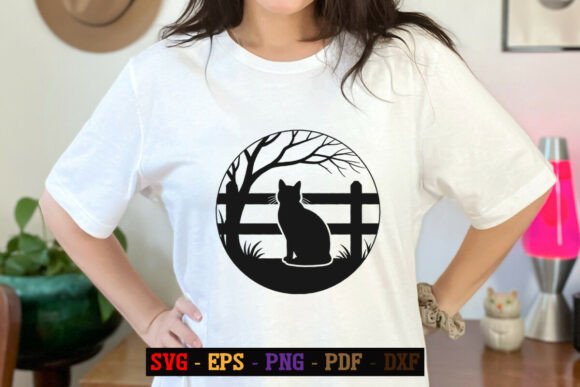
Cat Inside Circle Animal SVG Cat Vector
A Designer’s First Look: Clean, Friendly, and Ready for Real Stitching
When I opened the Cat Inside Circle Animal SVG Cat Vector, my first thought wasn’t “cute”—it was “practical.” The composition is instantly legible: a single cat centered inside a clean, unbroken circle. No extra flourishes, no overlapping elements, no fragile limbs poking outside the boundary. That circle does heavy lifting—it frames the design, simplifies hooping, and gives immediate visual rhythm. It feels like a logo sketch rather than a clipart afterthought. For embroidery designers who’ve wrestled with tangled vector paths or poorly spaced lettering, this is refreshing. The line weight is consistent, curves are smooth, and the cat’s expression reads as gentle—not cartoonish, not overly stylized—just quietly confident. That matters when you’re stitching it onto a baby onesie or a linen tea towel meant to last.
Where This Design Earns Its Keep (and Where It Doesn’t)
I tested Cat Inside Circle Animal SVG Cat Vector across three real projects: a medium-weight cotton tote bag, a 100% cotton crewneck sweatshirt, and a set of organic cotton baby burp cloths. On the tote? Excellent clarity—even at 3.5 inches wide, stitch definition held up. The circle acted as a natural stabilizer zone, minimizing fabric distortion around the edges. On the sweatshirt? Slightly softer read due to pile, but still charming—especially when stitched in matte cotton thread instead of glossy poly. The burp cloths were the real litmus test: fine fabric, frequent washing, delicate handling. Here, the design shined. Minimal fill areas, no dense satin borders, and generous negative space kept stitch density low and wash durability high.
That said, I’d avoid using Cat Inside Circle Animal SVG Cat Vector on ultra-stretchy fabrics like jersey knits without significant digitizing tweaks—no built-in underlay or pull compensation means stitches can shift. Same goes for curved surfaces like baseball caps: the flat circle shape doesn’t wrap naturally, so placement near the front panel seam requires careful positioning and possibly manual repositioning in your embroidery software. And while the design looks lovely on dark fabric in mockups, always test thread contrast—some light grays or beiges in the original color scheme may vanish on navy or charcoal unless adjusted.
What Makes It Work for Small Businesses and Makers
This isn’t just another cat graphic. As an Etsy seller and small shop owner myself, I see how Cat Inside Circle Animal SVG Cat Vector supports brand consistency and customer trust. Its simplicity translates cleanly across product types: embroidered on a linen apron for a local bakery, heat-applied as a patch on a denim jacket for a craft fair stall, or scaled down for a holiday ornament kit. Customers recognize clean, intentional design—and they associate that with care. When someone buys a personalized gift stitched with this file, they’re not just getting a cat; they’re getting cohesion. That circle becomes a subtle signature, especially when paired with minimalist packaging or cohesive social media mockups.
For digital product sellers, the included file formats (SVG, EPS, PNG, PDF, DXF) make it versatile beyond embroidery—think printable greeting cards, vinyl cut files for iron-on transfers, or layered Canva templates for boutique branding. But remember: if you’re selling finished embroidered items commercially, verify the license terms before listing. The product description says it’s a digital download—but whether it permits commercial use of physical products depends on the creator’s policy, not the file type.
Practical Embroidery Designer Notes You’ll Actually Use
- Always test on scrap fabric first—especially with textured weaves or blends. The circle’s edge can catch on loose threads if stabilizer isn’t matched to fabric weight.
- Check stitch density visually before sending to machine. Low-density fill works beautifully here, but some auto-digitized versions might overfill the cat’s body unnecessarily.
- Confirm hoop size compatibility. At standard sizes (3–4 inches), it fits most home embroidery hoops—but double-check if you’re scaling beyond 4.5 inches, where stitch jump risks increase.
- Inspect small details in black-and-white mockups. The cat’s eye and ear contours hold up well, but avoid shrinking below 2.25 inches—subtle curves start to blur.
- Use tear-away stabilizer for stable wovens (like tote bags), cut-away for knits or baby items. Skip fusible unless absolutely necessary—the design doesn’t need heavy backing.
- Compare light and dark fabric backgrounds in your design software before finalizing thread colors. A warm taupe thread pops on cream but disappears on oatmeal.
- Ask yourself: does this support the product’s purpose? On a kitchen towel? Yes—it’s cheerful but not childish. On a wedding guest book cover? Maybe not. Context shapes value.
Final Thought: A Quietly Versatile Craft Asset
Cat Inside Circle Animal SVG Cat Vector won’t shout from a crowded craft fair table—but it doesn’t need to. It’s the kind of design that earns repeat orders because it stitches reliably, photographs clearly, and feels handmade without looking handmade-*in-a-rushed-way*. It suits the quiet confidence of small business owners who value consistency over flash, and makers who understand that sometimes the strongest statement is a simple circle, a gentle cat, and space to breathe. Whether you’re building a line of nursery decor, launching a custom apparel side hustle, or stocking a local boutique with embroidered essentials, this file earns its place in your library—not as filler, but as a thoughtful, functional piece of design assets. Just remember: even the cleanest vector needs real-world testing. So grab your stabilizer, pick two thread colors, and stitch it first on something you don’t mind re-doing. That’s where the real work—and the real reward—begins.